
The Allen Park Wild Cards: 12 Surprise First-Round Picks That Could Break Your Brain
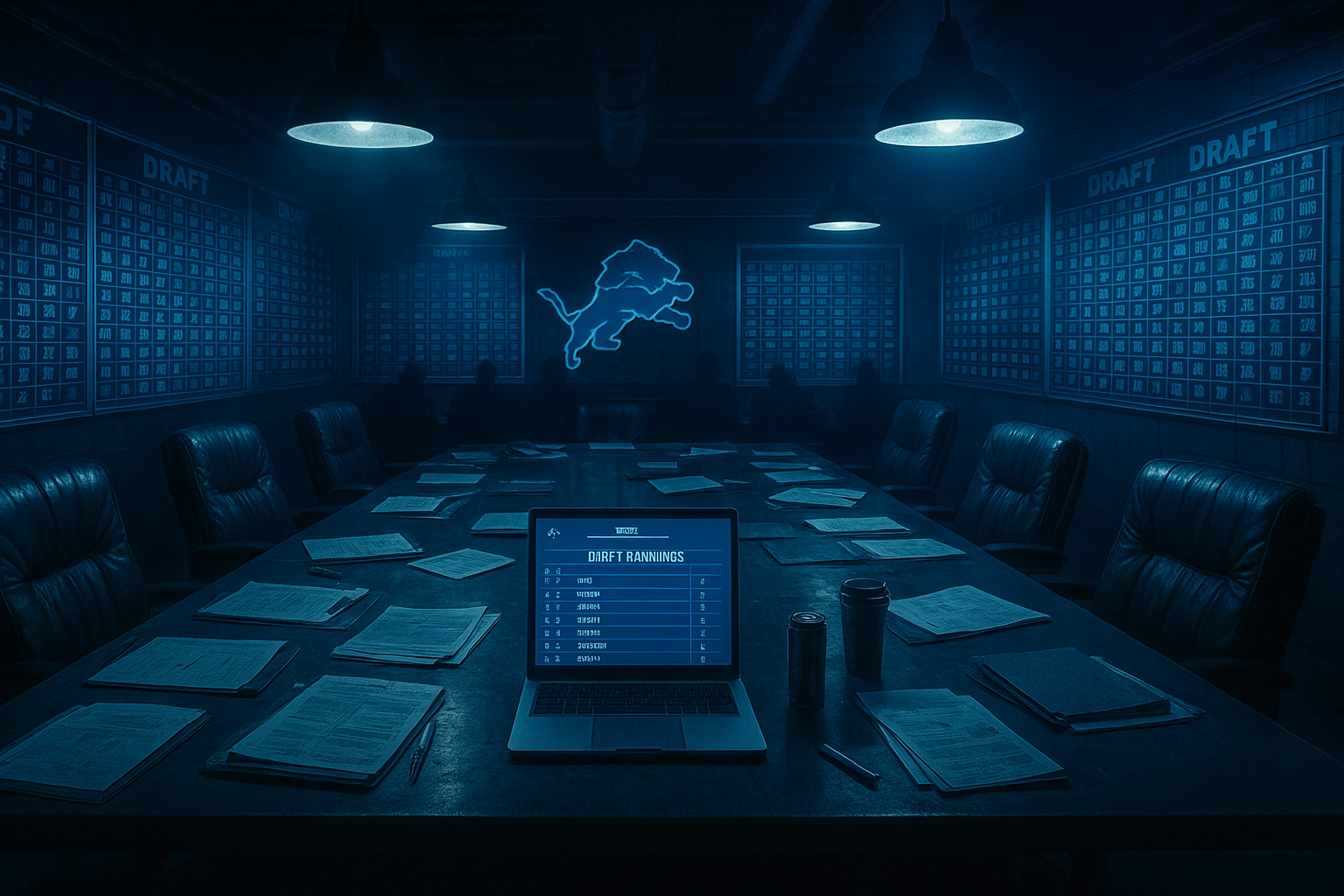
Look, we’ve been down this road before. Last April I threw out Ohio State defensive tackle Tyleik Williams as a potential “surprise” pick at 28, and guess what? Brad Holmes went ahead and made it happen. Because that’s what Holmes does. He looks at your mock draft, laughs, and picks the guy you had going in the third round.
The moral of the story? Allen Park is a vault when it comes to draft information, and expecting the unexpected is basically Lions Draft Strategy 101 at this point.

This year feels different, sure. The board at Pick 17 looks more settled, and after an underachieving step-back season, this pick is under more scrutiny than a Campbell timeout call in the playoffs. But here’s the thing about draft consensus: it’s often wrong, especially when it comes to what teams actually think behind closed doors.
I’ve left off the usual suspects everyone’s mocking to us. No Spencer Fano or Kadyn Proctor at tackle. No Keldric Faulk rushing the passer. And definitely no quarterbacks, running backs, or wide receivers, because if Holmes goes that route at 17, I’ll be formulating my acceptance speech until pick 50.
The Safety Valve Options
Dillon Thieneman (Oregon) – The consensus second safety in this class is trending toward the early first round, maybe as high as picks 11 or 12. But if he slides to 17? This is exactly the kind of pick that makes sense for a team that values versatility.
Thieneman started as a true freshman at Purdue and has been an athletic playmaker ever since. He can fill any role on the back end, brings the physicality to punish runners, and has the range to impact plays from sideline to sideline. The guy started all 39 possible games in college and averaged 7.9 tackles per contest.
For Kelvin Sheppard’s defense, Thieneman would be the ultimate chess piece. He could rotate into Amik Robertson’s old slot role while providing insurance for Kerby Joseph and Brian Branch. That’s the kind of flexibility modern defenses demand.
Treydan Stukes (Arizona) – Now this is where things get interesting. Stukes is ranked 60th on most big boards, but analysts have been quietly dropping breadcrumbs about his rising stock. And honestly? That fits the Lions’ MO perfectly.
Here’s a former walk-on who became a three-time captain, survived three head coaches and five defensive coordinators, transitioned from outside corner to full-time slot defender, and came back from a torn ACL in 2024. The guy plays with the kind of unquestioned reliability where you don’t need to ask if he’s going to show up. He just does.
Stukes reads and reacts downhill with authority, consistently eliminating throwing lanes before they develop. His film room preparation is legendary, which allows him to anticipate and trigger without hesitation. In Detroit, he’d align perfectly with Sheppard’s defensive identity as a versatile piece who can rotate between slot and safety.
Cornerback Depth
Chris Johnson (San Diego State) – While other corners bring more flash, Johnson brings a complete and translatable skill set. He’s experienced in press, man, and zone concepts, with the kind of coachable demeanor that resonates in Detroit’s culture-driven evaluation process.
Johnson has spent two seasons smothering receivers while bringing noise in run support. Given D.J. Reed’s age (29.4) and the uncertainty around Terrion Arnold entering Year 3, the fit makes sense. Plus, he offers special teams coverage value, and Dave Fipp loves that.
Avieon Terrell (Clemson) – A.J. Terrell’s younger brother has had an uneven draft cycle because he wasn’t built for the underwear Olympics. But like Brian Branch before him, Terrell showed well in on-field drills, and his tape tells a complete story.
Terrell plays bigger than his frame suggests, operating as a second-level enforcer who’s forced eight career fumbles. He’s comfortable in press-man situations, stays connected through routes, and showed versatility in the slot with effective blitzing ability. He’s a natural fit as a tone-setting, versatile defensive back.
Linebacker Reinforcements
Jacob Rodriguez (Texas Tech) – Rodriguez’s draft stock has risen faster than his wife’s Black Hawk helicopter. The former quarterback turned walk-on finished fifth in Heisman Trophy voting while collecting a bunch of other hardware.
The mustached marauder brings sideline-to-sideline range and plays like a heat-seeking missile. He’s slithery working through traffic and consistently finds the football. Sure, that aggressiveness can lead to missed tackles, but alongside Jack Campbell’s steadying presence, those inconsistencies can be minimized.
CJ Allen (Georgia) – Allen’s cycle has been the inverse of Rodriguez, with a November knee injury affecting his stock. But this is a guy who earned the role of quarterback of the the Bulldogs defense as a true freshman at Georgia. That’s serious trust and leadership.
Allen is widely regarded as extremely coachable with fast processing speed and high football IQ. The Lions haven’t hesitated to invest early at linebacker, and Allen’s stable violence would be a major draw as a tough play diffuser with a high floor.
Edge Rush Options
Zion Young (Missouri) – Young is a stout can-of-whoop-ass on the edge, leaving opposing blockers searching for Advil after four quarters. He’s a physical, tone-setting competitor despite some past off-field questions that Missouri’s coaching staff has vouched for.
Young generates superior power and urgency off the snap, using heavy hands to stonewall at the line. Like Gandalf the White, he makes it clear you shall not pass when teams try to run outside. His 16.5 tackles for loss senior season showed he put it all together.
Gabe Jacas (Illinois) – One of my favorite edge prospects to watch. His motor is non-stop, and he’s capable of contributing up and down the defensive front. Over two seasons, Jacas totaled 19 sacks and 26.5 tackles for loss with violent, well-timed hands.
There’s a controlled relentlessness to his game that’s straight out of Heat. He doesn’t freelance or chase plays, stays disciplined within structure, and trusts that consistent execution will break the offense down. That versatility and leadership profile fits what the staff could trust across defensive end responsibilities.
Interior Line Depth
Kayden McDonald (Ohio State) – McDonald projects as the successor to Tyleik Williams at nose tackle and shares similarities in play style. Despite just turning 21, he plays with grown-man strength, controlling A-gaps with power and leverage.
Like Williams, McDonald shows strong play diagnosis against the run and hustles snap-to-snap. Lance Zierlein compared him to D.J. Reader, reinforcing his fit. While there’s overlap with Williams, that skill set would maintain a deep, physical interior rotation.
Christen Miller (Georgia) – Miller is a punisher who leans on powerful upper-body strength to control blocks at the point of attack. He consistently handled single blocks and showed good range along the line, playing with active pursuit when tracking down ball carriers.
His workload was limited, averaging a career-high 31 snaps per game last season. In Detroit, he’d factor into a rotation behind Williams while mixing to give Alim McNeill breathers. That depth would provide added flexibility, particularly as they evaluate McNeill’s trajectory following injury.
Offensive Line Investment
Keylan Rutledge (Georgia Tech) – “Big Red” is a strong schematic fit for Detroit’s offensive line identity, with his main hurdle being the transition from right guard to left guard at the


I love the deep dive on these guys nobody’s talking about. Dillon Thieneman sliding to 17 would be such a smart move and honestly the kind of pick that makes Holmes look like he’s playing 4D chess while everyone else is doing checkers. If we can get a versatile safety like that in the first round, our secondary becomes so much harder to attack.
Look, I get the enthusiasm and Thieneman does make sense, but we’ve heard this ‘trust the process’ stuff before and it hasn’t always worked out. I’m not saying Holmes is bad at his job, I’m just saying I need to see it actually work more than once before I start coronating him as a genius. Let’s see how the pick plays out first.
This right here is what I love about Holmes’ approach. Back in my day we’d just take the obvious guy everyone wanted and hope it worked out. Now we got scouts actually looking at tapes and finding value in the margins. That Stukes kid sounds like the kind of gritty player this team needs, doesn’t matter if he’s a walk-on or not.
Kayden McDonald replacing Tyleik Williams? Yes please. Building that interior line depth is exactly what we need to keep our defense dominant. The more I read about these guys the more I’m convinced pick 17 is gonna be something special this year.